Agricultural Extension · Agricultural Economics · Agricultural Statistics · Computer Applications — taking pulse technologies to the farmer, and measuring what they are worth.
Established 1 August 2012
Introduction
The Division of Social Sciences was established on 1 August 2012 and comprises four disciplines —
Agricultural Extension, Agricultural Economics, Agricultural Statistics and Computer Applications. The
Division primarily focuses on research aimed at developing effective extension methodologies for the
dissemination and adoption of pulse-based technologies among pulse growers, and on assessing their
field-level applicability under farmers’ conditions. It is actively engaged in impact assessment of
pulse production technologies and programmes, valuation of ecosystem services, and assessment of the pulse
sector in India. The Division also develops online databases, information systems and AI/ML-based
decision-support tools for stakeholders across the pulse sector.
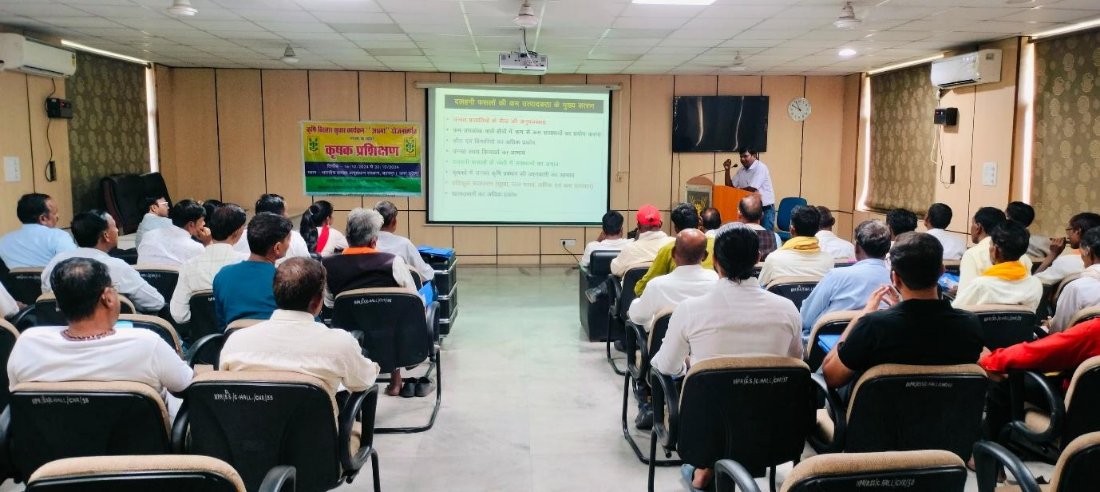
In addition, it conducts capacity-building programmes for farmers, extension personnel and agricultural
input dealers to enhance their knowledge, skills and technical capabilities. Besides research and
capacity building, the Division undertakes field-based extension activities including Farmers’ Days,
Field Days, Farmers’ Fairs, demonstrations and other farmer-oriented programmes.
4
Disciplines within the division
150
e-Learning video modules in five languages
2.84 lakh
Users of the e-Dalhan Gyan Manch portal
3,274
Demonstrations under the farming system approach
9,388
Tribal Sub Plan demonstrations, 2021–26
Focus
Thrust Areas & New Initiatives
Thrust areas
Development of innovative extension models for effective dissemination of pulse production technologies.
Strengthening the capabilities of diverse stakeholders across the pulse value chain.
Development of web-based databases and information systems on pulse crops.
Impact assessment of pulse production technologies and pulse development programmes.
Analysis of production, consumption, market pricing trends and trade dynamics, and development of forecasting models.
Documentation of farmers’ perspectives for the research and extension system.
Generating databases and farmers’ feedback for the research and extension system.
New research initiatives
Economic impact assessment of programmes promoting pulse production in India.
Valuation of ecosystem services of pulse-based cropping systems in the Indo-Gangetic Plains.
Assessment of India’s pulse sector using market-based policy simulation under supply volatility.
AI-based disease diagnostics and advisory in major pulses — chickpea, pigeonpea, greengram and blackgram.
Machine learning based prediction tool for detection of antimicrobial proteins in pulses.
Strengthening pulse value chains through an FPO-driven technology delivery model.
Major research achievements
Digital and AI-enabled Platforms
An e-learning portal on pulses (e-LeaP-P) was developed with 150 integrated video modules on pulse
production technologies, in Hindi, Marathi, Odia, Kannada and Tamil —
demoiipr.onistech.in.
The web portal e-Dalhan Gyan Manch was upgraded for access to improved pulse production
technologies by farmers and other stakeholders, and now has 2.84 lakh users —
dalhangyanmanch.res.in.
A database and information system for the Institute Gene Bank maintains data on more than 7500
accessions of major pulse crops.
An information system for IIPR donor registration and pulse varieties holds the characteristics of
37 registered donors and 78 released varieties.
A database of more than 8000 disease images and 9500 insect-pest images was built for chickpea,
pigeonpea, mungbean and urdbean, for an AI-enabled biotic and abiotic stress detection and advisory
mobile application.
An AI-based deep learning model has been developed for identification of yellow mosaic disease in
mungbean and urdbean.
The R package CompGR was developed to compute compound annual growth rate.
Economics
Impact Assessment of ICAR-IIPR Varieties
Economic surplus and risk-reduction benefits generated by nine varieties developed at the institute.
All values in ₹ million.
Economic impact of varieties developed by ICAR-IIPR
Variety
Crop
Check variety
Yield advantage
Total economic surplus
Annual surplus
Risk reduction cumulative / annual
GNG 1581
Chickpea
GNG 469
15%
45,805.28
3,817.00
1,062.57 / 89.00
IPC 2006-77
Chickpea
JG 14
14%
26,169.67
3,738.52
279.61 / 39.94
IPC 2010-134
Chickpea
KWR 108
13%
490.93
122.73
0.47 / 0.12
IPA 203
Pigeonpea
MA 6, Narendra Arhar-1, Bahar, MAL 13
20%
64,113.22
5,342.77
373.08 / 31.00
IPA 15-02
Pigeonpea
IPA 203
24%
8,882.39
1,480.40
4.92 / 0.82
IPU 11-02
Urdbean
Azad Urd 3
10%
20,723.39
2,590.42
1,025.81 / 128.23
IPU 13-1
Urdbean
Azad Urd 3
11%
23,192.56
2,899.07
1,076.06 / 134.51
IPL 526
Lentil
DPL 62
9%
3,527.50
352.75
22.29 / 2.23
IPL 534
Lentil
L 4076
9%
2,646.75
378.10
6.64 / 0.95
IPC 2006-77 figures are at 2022–23 prices; the IPA 203 surplus is projected up to 2029–30.
Extension research
Extension Approaches & Models
1
Functional Seed System Model
A functional seed system model depicting the roles of various stakeholders and the related
institutional linkages was developed as an outcome of experimentation, for improved access to quality
seed of farmer-preferred varieties at a reasonable cost and at the right time.
2
Farmer to Farmer Extension (FFE) Model
A farmer-led mechanism was developed for speedier diffusion of quality seed of pulse crops, through
action-oriented experimentation with 143 key farmers from the Bundelkhand region of Uttar Pradesh
during 2010–16.
The model was tested and found effective, delivering 2.7, 4.4 and 3.7-fold increases in the
number of farmers covered, the area sown and the quantity of seed made accessible respectively.
3
Social institutions for strengthening the pulse seed system
To address constrained availability of quality seed of improved pulse varieties in major pulse
producing regions of Uttar Pradesh, eight farmer-led institutions were formed as registered seed
societies and engaged in strengthening the formal and informal pulse seed system.
The societies collectively contributed 975.31 q of seed of all major pulse crops to
institutionalized government seed chains during 2016–17 to 2018–19 — sufficient to
cover 18,51,942 ha after conversion and multiplication — and facilitated diffusion of a further
550.59 q through informal social networks.
Farmers’ registered seed societies formed under the project
Sl.No.
Name of the farmers’ society
Members
District
1
Bairai Kisan Sewa Samiti
16
Jalaun
2
Silehera Kisan Sewa Samiti
12
Kanpur Dehat
3
Salempur Beej Vikas Samiti
13
Kanpur Dehat
4
Badapur Beej Vikas Sansthan
21
Kanpur Dehat
5
Khurahand Beej Vikas Samiti
12
Banda
6
Kusmara Beej Vikas Samiti
11
Hamirpur
7
Kalla Beej Vikas Samiti
12
Chitrakoot
8
Baglai Beej Vikas Samiti
13
Chitrakoot
4
Integrated extension model for Model Pulse Villages (M-Pulse)
The M-Pulse model was used to develop four Model Pulse Villages in Kanpur Dehat district, integrating
technological interventions (869 on 350 ha), capacity building (17 programmes, 1359 participants),
institutional development (4), value addition (2500 kg of pulses) and digital advisory services (2).
Interventions on pulse production technologies resulted in 31–59% higher yields and
increased income for partner farmers. Farmers’ societies produced 2654 kg of quality seed to
strengthen village-level seed availability and income.
Two pulse-processing hubs and two Custom Hiring Centres were set up to promote value addition,
mechanization access and rural entrepreneurship, generating gross income of ₹48,596.42 and
₹77,460 respectively.
Farmers were equipped with 200 storage bins, 198 sprayers, 97 sickles, 47 hand hoes, 25 IIPR manual
weeders and 25 IIPR herbicide applicators, improving labour efficiency and crop management and
reducing post-harvest losses.
5
Integrated farming system approach
Implemented with multiple technological interventions for food, nutrition and livelihood security of
rural households in Fatehpur district. Intervention modules covered pulse-based, cereal-based,
vegetable-based and livestock-based components together with entrepreneurship development.
During 2016–17 to 2025–26, 3274 technology demonstrations were conducted in project
villages of Fatehpur and Hamirpur districts — 1581 on pulses, 968 on cereals, 405 on vegetables
and 320 on oilseeds. Partner farmers recorded significant yield advantages throughout.
27 crop stage-based training programmes and 12 farmer–scientist interactions were organized in
the project villages, with 1855 partner farmers participating.
Demonstrations conducted, 2016–17 to 2025–26
Crop
No. of demonstrations
Yield advantage (%)
Pulse crops
Chickpea
527
28.82
Pigeonpea
51
47.12
Mungbean
612
23.88
Urdbean
277
16.78
Fieldpea
82
25.44
Lentil
32
28.72
Cereal crops
Wheat
590
24.66
Paddy
251
23.00
Maize
119
20.41
Pearl millet
8
2.39
Vegetable crops
Okra
139
16.166
Bottle gourd
51
22.31
Sponge gourd
41
18.23
Pumpkin
48
17.84
Chilli
73
23.19
Garden pea
14
12.32
Radish
29
—
Carrot
10
—
Oilseed crops
Mustard
228
26.16
Sesame
92
51.87
Total
3,274
—
Market research
Value Chains & Supply Chains
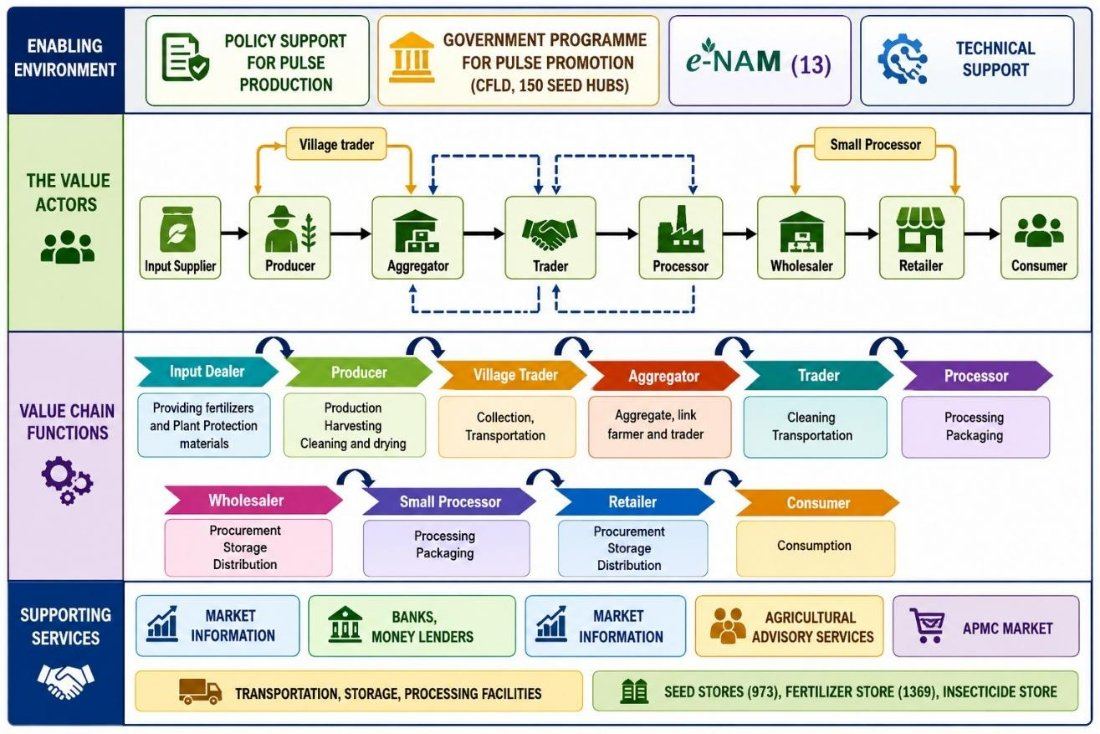
Value chains of pulses from the Bundelkhand region
The value chains of major pulse crops in the Bundelkhand region of Uttar Pradesh were documented to
generate empirical evidence for a better understanding of existing value chain dynamics among researchers
and policymakers. The findings are expected to facilitate appropriate technological innovations and policy
interventions to enhance farm returns and improve the efficiency of pulse value chains. Four channels were
documented:
Value chain map of chickpea in the Bundelkhand region of Uttar Pradesh
Mapping supply chains of pulses across major producing states
Supply chain mapping and performance assessment were conducted across seven states covering green gram,
black gram, lentil, chickpea, pigeonpea and field pea — the major pulse-growing states of Madhya
Pradesh, Uttar Pradesh, Karnataka and Rajasthan, and the relatively minor pulse-growing states of Bihar,
Jharkhand and Odisha.
Key supply chains were mapped through sampling of 46 districts, 94 APMC markets or blocks, 188 villages,
5610 farmers and 1504 supply chain actors. The study also documented the major challenges faced by
pulse growers, along with the use patterns of digital platforms in pulse supply chains and the associated
challenges.
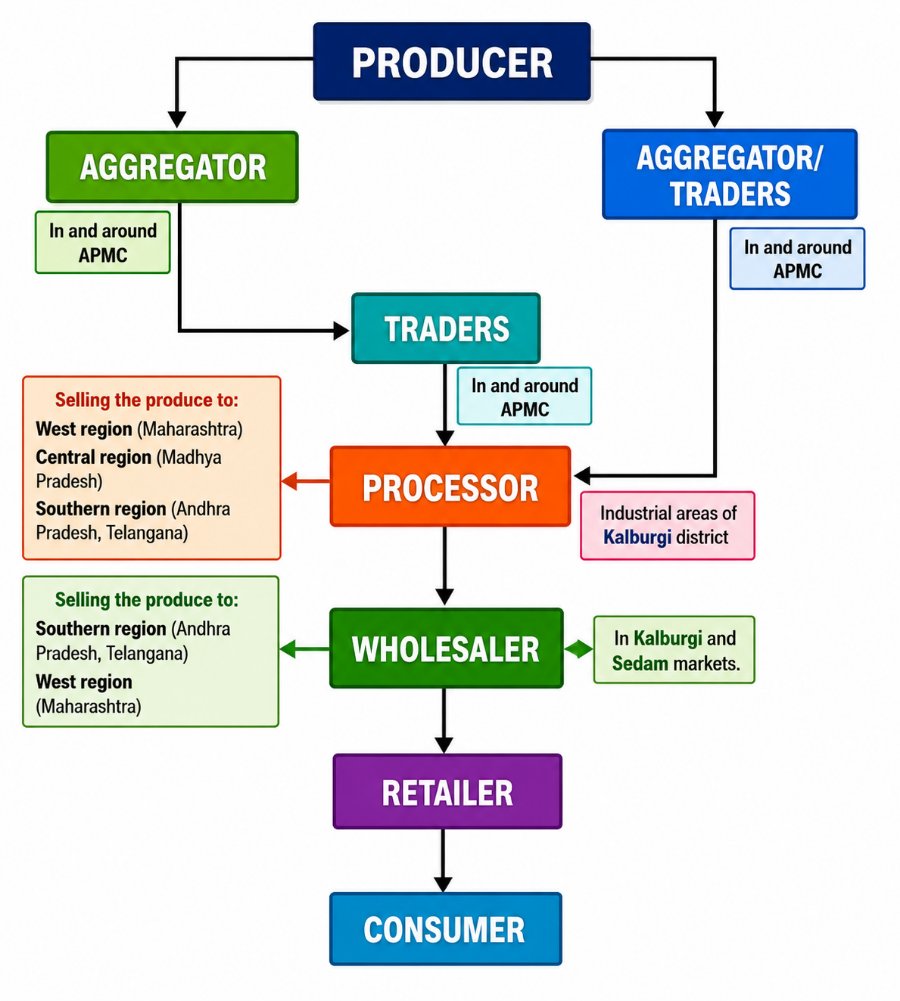
Supply chains of urdbean in Karnataka
Statistics & economics
Analytical & Forecasting Research
1
Growth performance and agroclimatic characterization
The R package CompGR was developed to compute compound annual growth rate. Agroclimatic
zone-wise CAGR was computed for pigeonpea, lentil, chickpea, blackgram and greengram across selected
states, for both area and yield, and district-wise growth rates were analysed for Madhya Pradesh,
Uttar Pradesh, Rajasthan, Karnataka and Bihar.
Compound growth rates of area, production and yield of lentil were positive, with low instability.
Decomposition analysis reveals that the change in production is due to yield, area and their
interaction together.
Biplot analysis and principal component analysis were performed on maximum and minimum temperature,
relative humidity and rainfall recorded during the chickpea growing season (September–April)
from 2018 to 2024, drawn from the NASA POWER database. Plant characters — 100-seed weight, days
to 50% flowering and days to maturity for 2010–11 to 2022–23 — were taken from the
AICRP on Chickpea / Rabi Pulses. Combined analysis identified outlier locations within each
chickpea-growing zone.
2
Prediction tool for antimicrobial proteins in pulses
A genome-wide search was carried out for classes of antimicrobial proteins — alpha/beta
thionins, hevein-like peptides (chitin binding domain), glycine-rich peptides, snakins, gamma
thionin, and lipid transfer proteins 1 and 2 — across eight legumes: chickpea, pigeonpea,
mungbean, blackgram, common bean, field pea, cowpea and lathyrus.
The results confirm five classes of AMPs in all selected legumes — heveins (70), snakins (197),
LTP-1 (750), LTP-2 (850) and gamma thionin (100). Lathyrus and field pea contain glycine-rich
protein. The 3D structure of the identified AMP sequences for chickpea and blackgram was generated
using AlphaFold 2.
3
Development of the pulse outlook for India
Based on Household Consumption Expenditure Survey (NSSO) 2023–24 consumption patterns, future
pulse demand was estimated using behaviouristic and normative approaches. The behaviouristic
approach — accounting for consumption behaviour, income and demographic change — projects
direct pulse demand at 19.61 million tonnes by 2050, while the ICMR-based normative approach
estimates the direct requirement at 47.80 million tonnes. The gap underscores the need to
enhance pulse production, productivity and consumption to achieve nutritional security and
self-sufficiency.
4
AMMI-based selection for yield and stability in chickpea
Multi-environment trials generally show significant genotype main effects and genotype ×
environment interaction, so univariate and multivariate stability methods are used to study it. The
Additive Main effects and Multiplicative Interaction model was applied to support breeding
programmes through genotypic stability.
A stability index weighting yield and stability (yield weightage 50% and 75%; stability weightage 50%
and 25%) was used to rank 40 promising chickpea genotypes — the higher the index, the better the
genotype. These were evaluated at seven south-zone locations of the AICRP on Chickpea programme
during 2015–16: Hiriyur, Nandyal, Coimbatore, Dharwad, Lam, Bijapur and Gulbarga.
Outreach
Technology Interventions
Demonstrations across Uttar Pradesh
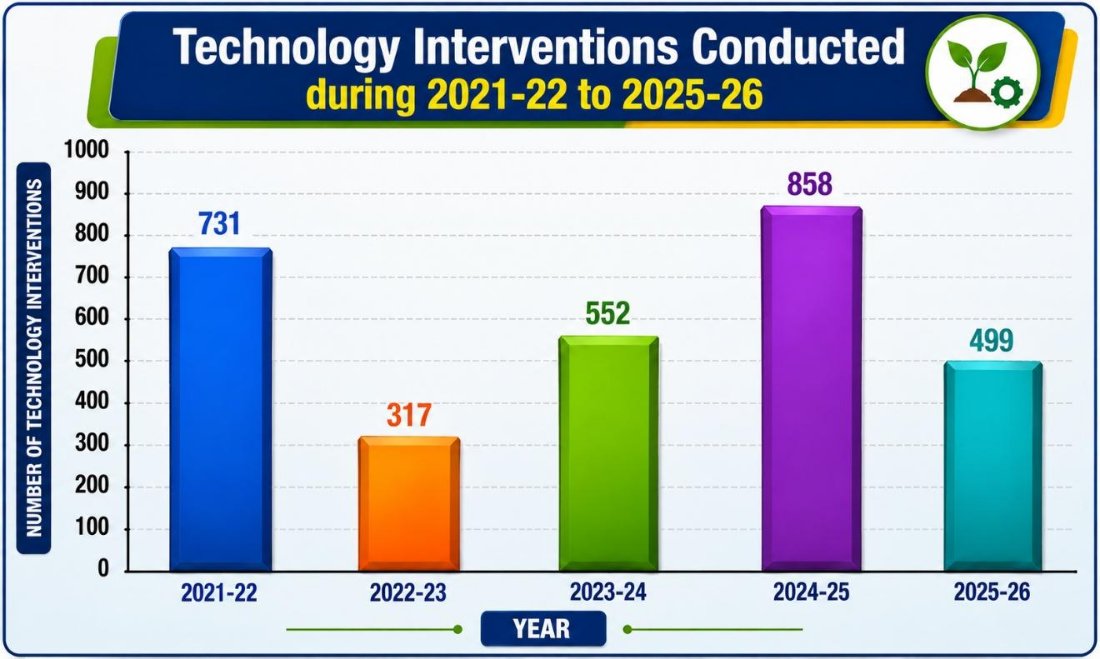
The Division conducted a total of 2957 technology demonstrations on pulse technologies from
2021–22 to 2025–26, across different production situations and agro-climatic zones of Uttar
Pradesh. These included front line demonstrations and participatory demonstrations under various
programmes, featuring recommended situation-specific high yielding varieties along with matching pulse
production technologies.
Tribal Sub Plan
To enhance pulse production for food and nutritional security and the rural livelihoods of tribal farmers
in Madhya Pradesh and Chhattisgarh, 9388 demonstrations on improved pulse production technologies
were conducted in tribal districts of the two states during 2021–22 to 2025–26. Tribal farmers
also participated in training programmes and field days.
Technology interventions conducted during 2021–22 to 2025–26
Computer applications
Software, Databases & Portals Developed
1
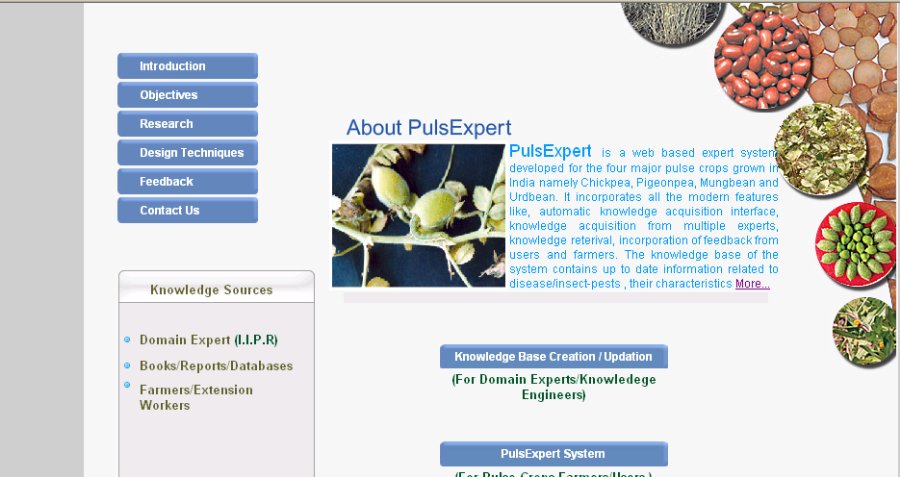
PulsExpert — expert system for diseases and insect-pests
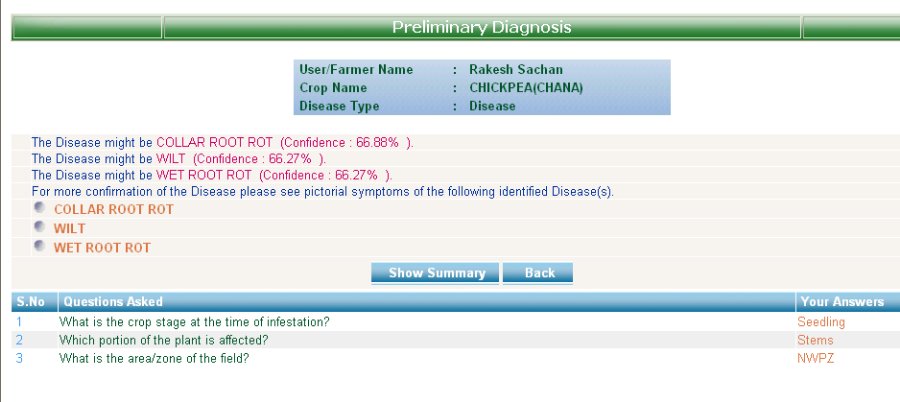
A web-based expert system for the major pulse crops grown in India — chickpea, pigeonpea, mungbean, urdbean, lentil and pea. Its automatic knowledge acquisition system gives domain experts a friendly interface for entering, storing and structuring knowledge. The knowledge base covers 24 major diseases and 33 major insect-pests appearing from seedling to maturity. Farmers answer textual and pictorial symptom questions, and the system diagnoses the disease or pest with a confidence factor and suggests cultural and chemical control measures.
PulsExpert home page
Preliminary diagnosis with confidence factors
2
Online data submission & retrieval system for MULLaRP
Developed to speed up data collection, compilation, analysis and report generation for coordinated research trials in MULLaRP crops. The system has three online modules — plant breeding data entry and submission, data analysis, and report generation. The analysis module performs RBD analysis; the report module generates information sheets and location-wise data by crop, trial, zone and location. Built in ASP.NET with C# as front end and SQL Server 2005 as back end.
MULLaRP online data submission and retrieval system
3
Database and information system for plant genetic resources
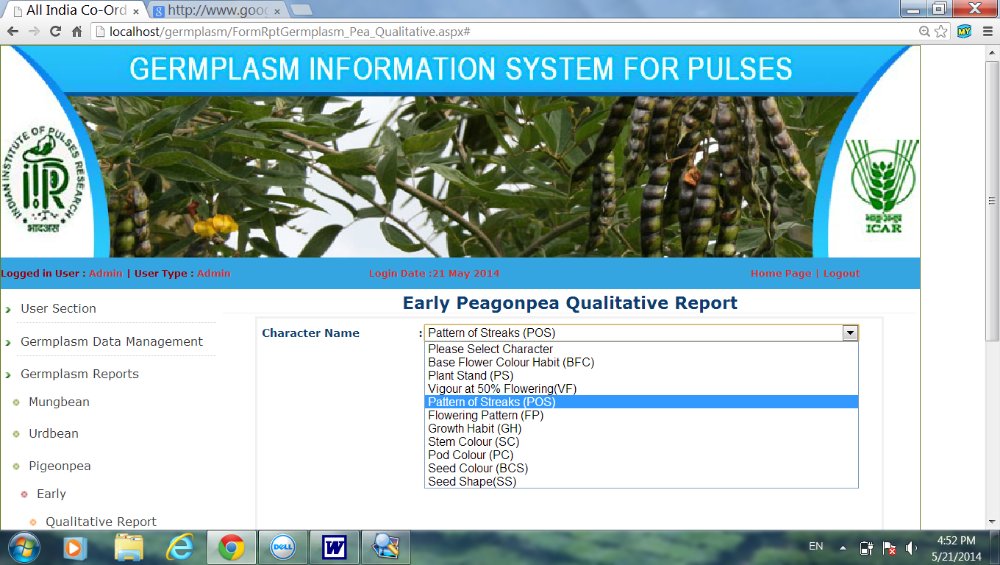
Holds data on 1097 chickpea, 1058 pigeonpea, 550 mungbean, 734 urdbean and 480 field pea germplasm accessions, including agronomical, morphological and other traits. It has two components — germplasm data management for entry, updation and submission, and report generation to retrieve or search germplasm information on a single character or a combination. Four main reports can be retrieved: qualitative, quantitative, query-based and detailed.
Plant genetic resources database and information system
4
Web-based commodity profile for pulses (CPP Portal)
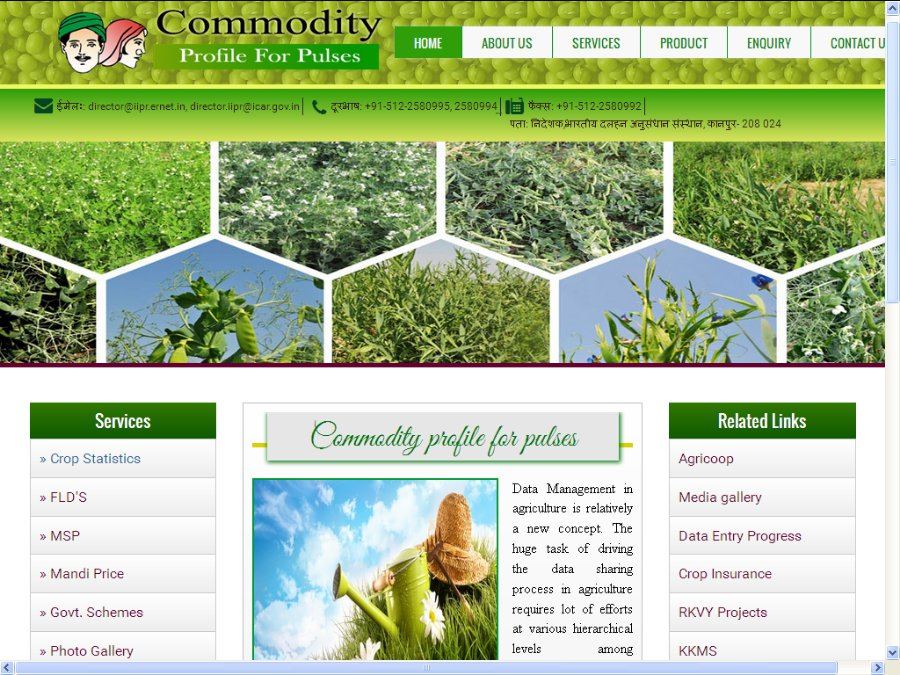
A digital platform built on available information related to improved production and protection technologies together with pulse production and trade statistics. Soil data, weather data, minimum support prices, breeder seed production, major export destinations and import sources, and the crop planner / crop calendar feed the data management portal. The system runs on Linux and Windows, with MySQL and Apache as database and web server, PHP for server-side scripting and HTML, CSS and jQuery on the client side.
Web-based commodity profile for pulses
5
Farmer mobile applications for pulses on the mKRISHI platform
A collaborative project with Tata Consultancy Services in which a pilot platform was designed around the best package of practices for better returns in chickpea, pigeonpea, mungbean, urdbean, lentil, fieldpea and rajmash, through a digital connection with farmers. The platform provides a two-way interactive system between farmers, scientists and other stakeholders, with a web console customised for farmer management, knowledge management, advisory management, information management and support services.
mKRISHI farmer application
mKRISHI web console
6
E-Pulses Data Book
A state-wise database and information system designed and developed for chickpea, pigeonpea, mungbean, urdbean, lentil, field pea and total pulses, covering the period 1980–81 to 2023–24. The database is also published on the institute website, where the data can be accessed and downloaded as an e-data book.
E-Pulses Data Book
Facilities
Available Infrastructure
Institute museum
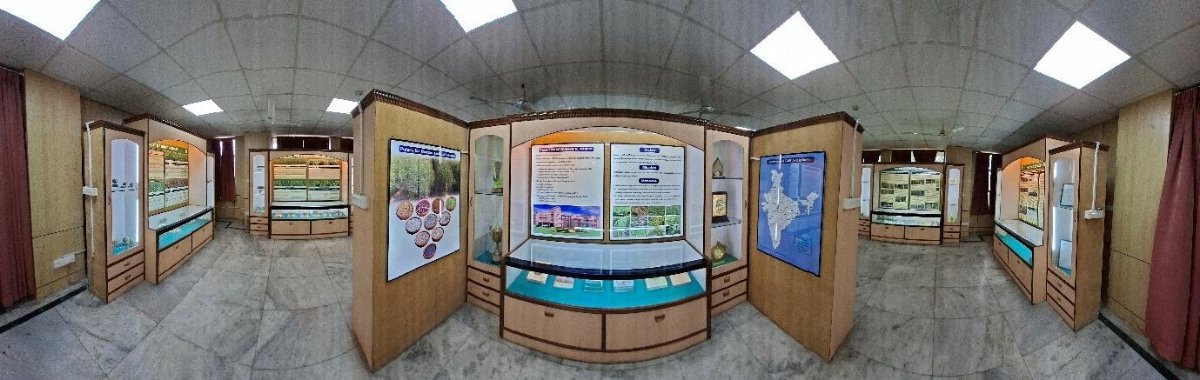
The institute museum is located in and maintained by the Division of Social Sciences. It is a
state-of-the-art museum on pulse crops depicting the pulse production technologies developed by the
institute and its major focus areas of research. The displays also cover the institute’s mandate,
timeline, presence across the country and major milestones achieved.
Training hall
A fully equipped training hall with a seating capacity of 75 people is available at the Division of
Social Sciences. The hall has fully functional multimedia projection facilities with internet
connectivity.
Institute museum, maintained by the Division of Social Sciences
Databases, information systems, decision support and expert systems, mobile applications, network management and security.
Current area of research
AI-enabled mobile application for disease and insect-pest detection and advisory in pulses; database and information system for pulse milling attributes; web-based portals and ICT applications for pulses.
Major research achievements
Pulses Seed Hub Portal; IIPR Gene Bank information system (Pulse_GeneBank).
Online software for donor registration and IIPR pulse varieties.
Diseases / insect-pests database and information repository for pulses.
Database and information system on milling quality parameters and processing characteristics of pulse varieties.
E-Pulses Data Book.
Seven copyrights registered, one trademark, three copyrights filed, seven software developed, 52 research articles published and 25 farmers’ trainings organised.
Awards and recognitions
Fellow of the Indian Society of Pulses Research and Development, ICAR-IIPR Kanpur
Reviewer — Indian Journal of Agricultural Sciences, International Journal of Science Technology & Engineering, Pantnagar Journal of Research
Member, Institute Management Committee, ATARI Jodhpur
Best Team Award (Farmer FIRST project); three best paper and five best poster presentation awards